How the tiers are aggregated
How 29 sources are separated into rankings and opinions, which records contribute scores, and the limits involving reposts, preference-based low ratings, and Part I inputs.

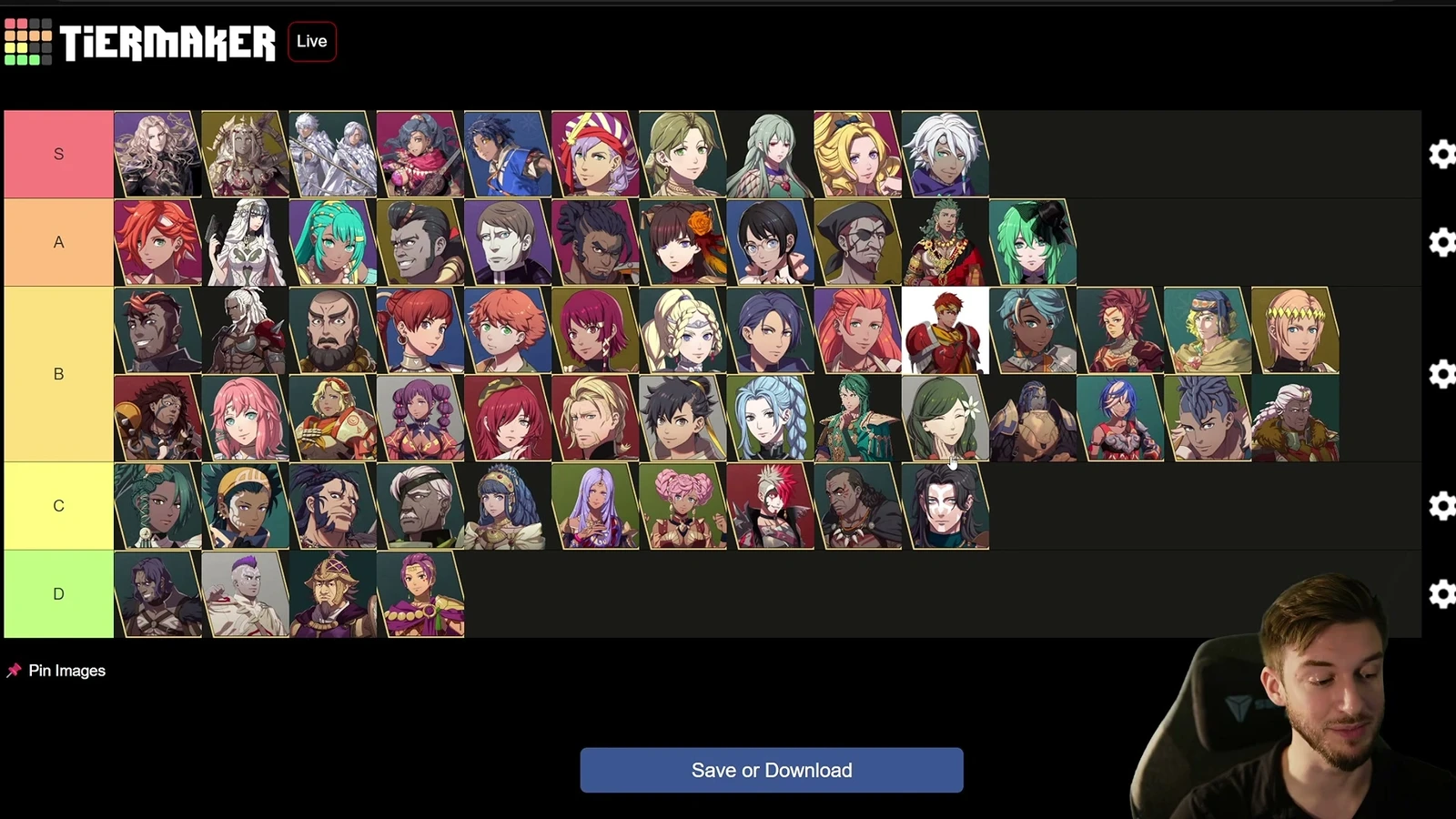
Overall scores combine multiple assessments to narrow your choices. Identify what your team lacks, then compare tiers under similar training conditions.
An overall score is a weighted combination of assessments; expected stat growth is calculated separately. Assessments differ in route, stage, and investment. Start with those closest to your conditions, then consider team needs rather than a few points of difference.
The 15 include top-ten lists, protagonist-only rankings, limited two-route ratings, and reposts. Their coverage and independence vary, as does each character’s actual vote count. Original rankings and reasons preserve each assessment’s scope and disagreements.

1. Tier conversion does not invent missing votes
Each valid tier list is converted at equal intervals from 100 for the top tier to 0 for the bottom. For example, a six-tier SS/S/A/B/C/D list becomes 100/80/60/40/20/0. This is the site’s aggregation rule; the original assessment does not necessarily consider adjacent tier gaps equal.
- Protagonist categories and the four-protagonist ordering do not enter linear scoring.
- One list covers only the top ten on Leda’s route. The current rule adds 8 to their Part 1 scores without inventing a full tier list from a top ten.
- Unclear spoken tiers inferred from context carry “?” and have their weight multiplied by 0.5. Characters without a clear assessment receive no invented tier; training-only videos do not vote.
- Training supplements by the same author are not new independent ratings. Fianna’s training guide repeats her old B rating, and another lineup guide adds training advice; neither is counted again alongside its author’s overall list.
2. Source weights and evaluation perspectives
The approaches below contribute with these weights. Registered sources, actual tier records, and independent authors are three different counts.
| Source | Weight | Perspective and main limits | |
|---|---|---|---|
| Approach 1 | 1.0 | Full game; considers progression, endgame, joining, and ease of training | |
| Approach 2 | 1.0 | Full game; mainly Part III, without recruitment difficulty | |
| Approach 3 | 0.8 | Full game; emphasizes Part III and skills | |
| Approach 4 | 0.6 | Full game; ranks by role, so comparisons across roles need care | |
| Approach 5 | 0.8 | Full game; assumes easiest recruitment route; protagonist categories do not score | |
| Approach 6 | 0.5 | Full game; few individual explanations | |
| Approach 7 | 1.0 | Full game; Hard clear with personal preferences, discussed below | |
| Approach 8 | 1.0 | Full game; Hard Classic, focused on Part III, with at most two complementary routes | |
| Approach 9 | 1.0 | Full game; 59 explicit rankings, judged by general clear utility and investment | |
| Approach 10 | 1.0 | Full game; 63 rankings, at most dual-route fusion; some characters not thoroughly tested | |
| Approach 11 | 0.3 | Full game; Part 2 explicitly rates 45 characters; shares its source with Approach 1 | |
| Approach 12 | 0.6 | Part I; 46 recruitable characters; protagonist order stored separately without scoring | |
| Approach 13 | 0.8 | Part I; ending Part III comments remain mixed into the inputs, awaiting separation | |
| Approach 14 | 0.3 | Part I; a single-route top ten provides bonuses only | |
| Approach 15 | 1.0 | Part I input; only 7 spoken ratings from two routes, including inferences and revisions; not a full Part I roster list |
The other 14 registrations mainly discuss training, lineups, mounts, or specific evasion setups, or have empty transcripts. They can explain reasoning but currently have no tier records and do not enter the tier average. Chinese-source records have been filled in batches of 59, 63, 45, and 7, totaling 174. Being discussed does not necessarily mean a character received a tier vote.
3. Score bands and blank Part I tiers
Average scores of ≥88 give SS, ≥72 S, ≥58 A, ≥42 B, ≥20 C, and the rest D. SS means the overall score falls in the highest band. Ordering within each tier uses the same algorithm.
The full-game view combines campaign contribution with Part 3 roles. Some assessments emphasize Part 3; others assume particular resources and merges. Part 1 inputs include limited two-route ratings beyond the original three early sources, and late-game comments in those ratings must be separated from Part 1 assessments. The current rule requires at least two valid sources to display a Part 1 tier; special protagonist categories and top-ten bonuses follow the rules above.
Align difficulty, stage, and resources before comparing
One assessment assumes Hard Classic, fast progression, substantial Part 3 weighting, and complementary training across two routes. It excludes extreme investment such as recruiting everyone on four routes or using Dance to grind to level 99. “Usable” reflects that investment level; intensive training can make the character stronger.
Another draws on roughly 300 hours and considers joining, skills, stats, routes, and resources, with at most dual-route fusion. Not everyone was thoroughly trained. High ratings for characters such as Peter include a secondary route to improve Strength and cannot be applied directly to a single-route archer.
Another overall list uses the highest difficulty available at the time and Classic mode, though the exact difficulty name is unclear, and values general usefulness and availability. Individual guides distinguish low investment, heavily supported single-route training, and intensive multi-route training. Compare final stats within the same investment category.
The limited two-route ratings cover firsthand experience only on Leda’s and Dietrich’s routes. Some characters received little training, and Part 3 comments are mixed in. No difficulty or uniform merge cap is stated. Their scope is limited to that experience.
Among the other assessments, two video rankings use Hard, one role-based list uses Hard, and another uses Normal plus Hard. Difficulty remains unknown where unstated. Video publication dates are listed in their sections, but article registration dates cannot establish a game version. There are currently too few assessments matched by version, difficulty, and investment to rank separately by difficulty.
Scoring limits from shared sources, preferences, and blanks
- Reposts still duplicate votes from the same source. One multipart summary comes from an existing Japanese list, yet its Part 2 still enters the overall score at weight 0.3. Lower weight does not make shared material independent evidence.
- Dadao’s D includes personality preference. The full-roster list puts him in D because the author dislikes his personality, while estimating low B to C on stats alone. The Part 1 list gives B. The aggregate still includes the original D; the data owner must decide whether to exclude it.
- Part 1 inputs have scope gaps. Hong Hua A and Eshmel S at the end of one Part 1 video are additional Part 3 comments, but the data records them under the Part 1 source. Both currently have blank final Part 1 tiers; this does not mean they are recruitable in Part 1. Dietrich, Leda, and Theodora have reason cards without confirmed explicit tiers; check the original ranking screen before adding them.
Choose recruits for the gaps in your save
- 1Match the stage:Select your current stage first.
- 2Find the team gap:Decide whether you need damage, healing, or durability.
- 3Check investment:Review recruitment and training costs.
- 4Check current stats too.Random growth makes the same character perform differently between saves. At minimum, record level, class, route, merges, and equipment when comparing. Weighted assessments cannot guarantee this save’s Strength, Hit, or survival thresholds, and one poor growth outcome does not prove a character is always weak.
Late recruitment reduces campaign contribution and training time, but high-base Creek and Sofia’s healing without intensive training are exceptions. Earlier recruitment does not always mean greater strength.