
Skill ranks
Attacks grant skill EXP only when they hit and deal positive damage. Arena partners with higher relevant ranks help weaker partners; each menu has one use per week. One Clash test found a 15-round cap, reached only if enemies survive long enough.

For weekly arena training, pair the learner with someone strong in the relevant skill. For concentrated grinding, enter a Clash and retreat at the experimentally measured 15-round cap.
- Skills have 12 ranks, E→S+. Reaching S+ from E takes 2560 total EXP. Prioritize the rank needed for your next exam or combat art. Attacks must hit and deal damage to earn skill EXP; 0 damage does not count. EXP is awarded per round of combat, so follow-ups and multi-hit attacks do not give another award for each hit.
- Each arena training menu is available once per week for two characters. Pair a higher-ranked character with a lower-ranked learner. The learner receives bonus training EXP from the expert. This checks ranks in the relevant training skill, rather than character levels. Spectating gives skill EXP to everyone; which skills improve depends on the match.
- To grind skills, leave enemies alive in a Clash, press + to skip, then retreat and reenter. Experiments found a cap of 15 rounds of skill, class, and movement-type EXP per Clash. A second enemy wave does not reset the count. Clearing enemies early gives fewer than 15 rounds. A weak weapon must still deal at least 1 damage; 0-damage attacks cannot sustain training.
Why do more strikes not always train faster?
A combat round differs from an individual hit. Follow-ups, triple attacks, and quadruple attacks within one round do not multiply skill EXP by their hit count. Taking ranged attacks without dealing counterattack damage also does not train Heavy Armor just by getting hit.
You can use weaker weapons to prolong training, since one-hit kills end it early. However, zero-damage attacks and misses grant no attacking skill EXP. Weak weapons keep enemies alive for more rounds; they do not turn a single round’s combo into additional EXP awards.
Weapon skill EXP per valid combat = base 1 + character aptitude + current class bonus + Boons of Salvation bonus. Aptitude adds +1 for a strength, 0 for neutral, and −1 for a weakness. Add the bonuses for the current character, class, and boons; a weakness can cancel the base 1 EXP.
For example,  Ludia is strong in Sword, neutral in Gauntlet, and weak in Axe. In one Warrior setup with all Blessings, positive sword damage awarded 7 EXP, while axes and gauntlets awarded 6 each. These totals add the four terms above. Check character affinity, current class, and unlocked Blessings before calculating. Do not reduce damage to zero just to extend combat.
Healing white magic also provides training. Let an ally take damage, then cast healing spells repeatedly. Retreat when uses run out or the enemy is close to dying, then replenish spells. The positive-damage requirement applies only to attacks.
Use skilled partners to improve weak skills each week
Arena training menus rotate weekly. Training normally costs 300G, with half price on weekends and relevant holidays. Renown level 4 upgrades training to level 2; Renown level 7 upgrades it to level 3.
- 1Check which skills the current training covers.
- 2Pair the target character with someone strong in those skills. Check the relevant skill ranks, rather than character levels.
- 3Check your budget and both characters' Motivation before starting. Training costs money and each character's Motivation.
Player tests recorded the following level 3 training EXP:
| Component | EXP |
|---|---|
| Good/Excellent/Perfect base value | 25/30/37.5 |
| Strength in the skill | +17.5 |
| Instruction bonus for the lower-ranked participant | +12.5 per half-rank step, including “+” ranks; maximum +50 |
| Rounding | Add all components, then discard the decimal portion |
For example, D→D+→C→C+ is a gap of three steps, giving the D-ranked participant 37.5 extra instruction EXP. At level 3, a Perfect result, a skill strength, and the maximum instruction bonus total 105.
Another comparison kept the target character fixed and switched between higher- and lower-ranked partners. The target gained more with a higher-ranked partner. Pair a higher-ranked character with a lower-ranked learner for bonus instruction EXP. Whether the expert receives the same bonus remains unconfirmed.
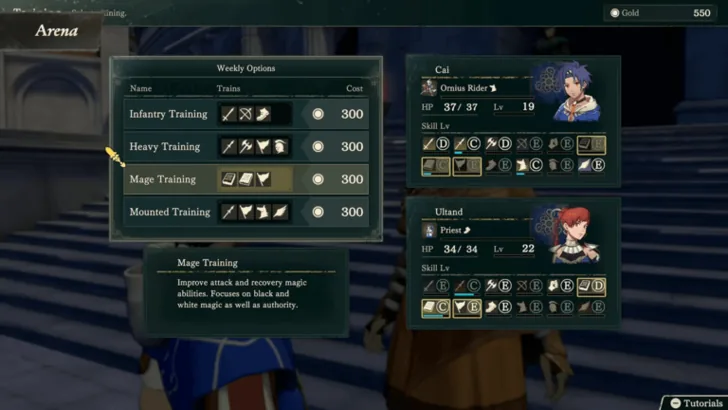
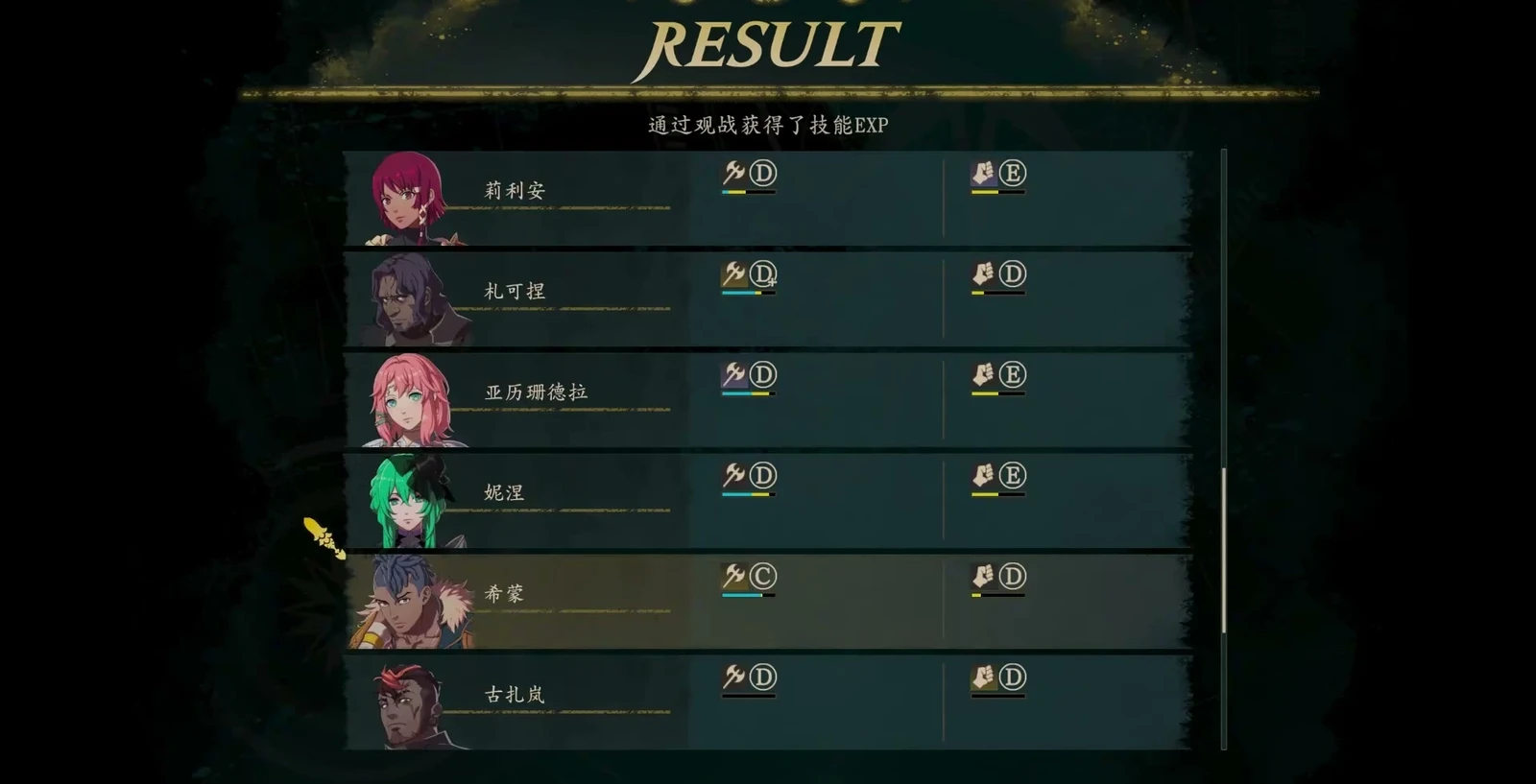
Spectating is separate from two-person training. It gives skill EXP to everyone, with gains related to the skills demonstrated in the arena. Everyone benefits; check the results to see which skills improve. How victory or defeat changes the skills and quantities remains unsettled, so check each match's results.
Retreat at the 15-round cap when farming skills
One experiment used skill manuals worth 20 EXP each to measure a remaining requirement of 84 EXP. At 5 EXP per round, 15×5 = 75, leaving 9 after the battle. Skipping additional rounds and fighting two enemy waves still left 9. The resulting inference was a maximum of 15 counted rounds in that test, with no reset between waves. Under that result, endlessly stalling against sandworms gains nothing further. To farm, establish sustained combat before planning your retreat:
- 1Find a dungeon enemy group you can safely endure and prepare protection and support. Use a low-damage weapon that can hit and deal at least 1 damage.
- 2Draw in two enemy groups together if possible, ensuring the last group survives 15 rounds. High-bond Soldiers can provide protection bonuses to reduce the risk of injury.
- 3Enter a Clash, confirm that both sides can keep fighting, then press + to skip. Training ends when all enemies are defeated.
- 4Retreat before the last group is defeated to retain skill EXP and reset the enemies.
This demonstration is not restricted to Part 3; you can do it early too. Cavalry and flying units cannot use it to train Riding or Flying inside dungeons. Magic cannot loop indefinitely like physical weapons.
EXP table from E to S+
When calculating skill EXP, “to next rank” is not the cumulative EXP needed to reach the current rank.
| Current rank | To next rank | Total from E to current rank |
|---|---|---|
| E | 20 | 0 |
| E+ | 15 | 20 |
| D | 45 | 35 |
| D+ | 140 | 80 |
| C | 220 | 220 |
| C+ | 250 | 440 |
| B | 220 | 690 |
| B+ | 305 | 910 |
| A | 295 | 1215 |
| A+ | 450 | 1510 |
| S | 600 | 1960 |
| S+ | — | 2560 |
Another table lists 220 for A→A+ and 445 for A+→S, differing from the 295/450 above. Other records explicitly use a total of 2560 and 600 for S→S+. The differences between versions have not been fully explained, so mixing tables would not establish a single definitive high-rank threshold.
A level catch-up option does not replace skill training. The level 36 Commoner example shows that the War story can raise an underleveled character's level, but without earlier weapon training they may still fail the requirements for their desired class. Even characters you are benching can train the required skills in the arena ahead of exams. Level 36 was the result in this demonstration; check the actual catch-up level in your save.
Skill EXP does not accumulate per strike
Train toward your next goal. For a new weapon, check its required rank; for a Combat Art, check the character’s learnset; for a class change, check Certification; for higher-level Battalions, check Authority and Battalion assignment. You can stop once you have enough instead of maximizing every skill first.
- Follow-ups and multi-hit attacks do not multiply skill EXP by hit count. Weak weapons extend the number of combat rounds.
- Attacks dealing 0 damage cannot train skills. Healing white magic is a separate, effective training method.
- The experiment's 15-round cap cannot be reset by skipping again or adding another wave. Clearing enemies early gives fewer than 15 rounds.
- Automated training and manuals also improve skills. Use weekly training and spectating when available instead of relying entirely on dungeon grinding.
- There are 12 skill areas: Sword, Spear, Axe, Bow, Gauntlet, Black Magic, White Magic, Infantry, Riding, Flying, Heavy Armor, and Authority. The 12 ranks from E to S+ apply within each area; these are two different sets of 12. Check what the target character learns at each rank before choosing a skill to train.