
Combat formulas: follow-ups, Hit, Crit, and damage
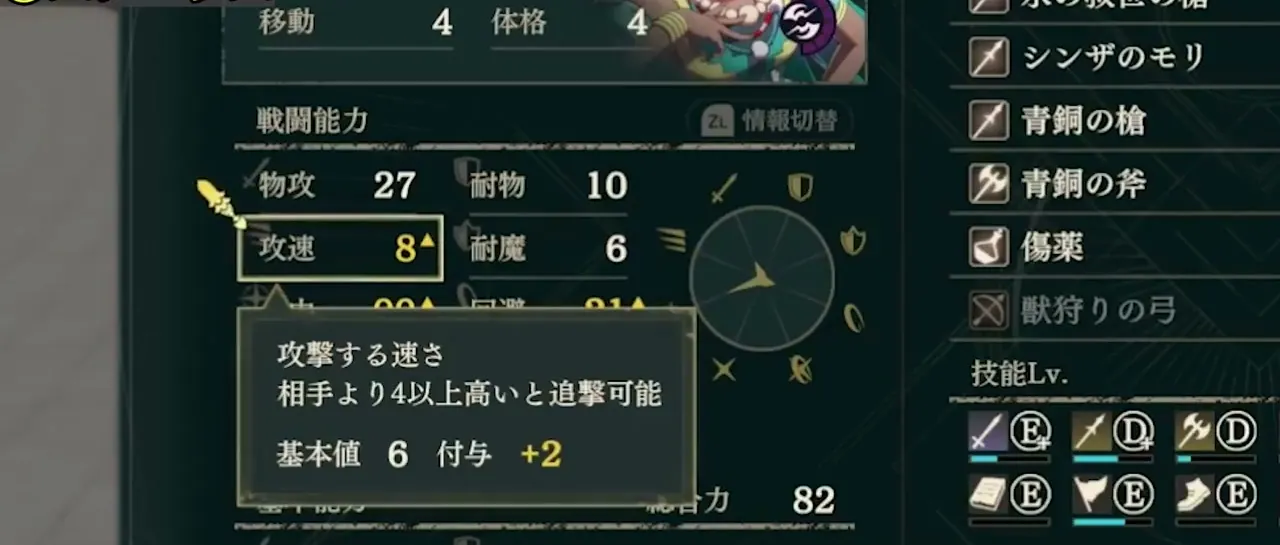
A follow-up requires at least 4 more Attack Speed. Attack Speed = Speed − max(0, total equipped weight − Build), plus skill modifiers. Base Build is Strength / 5, rounded down, with skills, equipment, and mounts added separately.

You need at least 4 more Attack Speed than the opponent to follow up. Excess equipment weight lowers Attack Speed; if you narrowly miss the threshold, check whether you can remove a shield.
- Follow-ups require an Attack Speed gap of 4. Attack Speed = Speed − max(0, total equipped weapon and equipment weight − Build), with skills added separately. Weight within Build causes no penalty and does not add Speed. Base Build is Strength / 5, rounded down, plus skills, equipment, and mounts. If you narrowly miss a follow-up, you can remove an unnecessary shield at any time on player phase before attacking.
- Physical Hit uses Dexterity; physical Avoid starts with Attack Speed. Excess equipment weight hurts both follow-ups and physical Avoid. Check the current target’s forecast separately for magic Hit and magic Avoid rather than copying the physical formula.
- Damage = weapon Might + Strength − Defense. Critical hits multiply final damage by 3. There is no sword–spear–axe triangle. Each weapon type instead has its own trait: sword follow-ups deal 1.2× damage, axes deal at least 5 damage on hit, and gauntlets help you dodge.
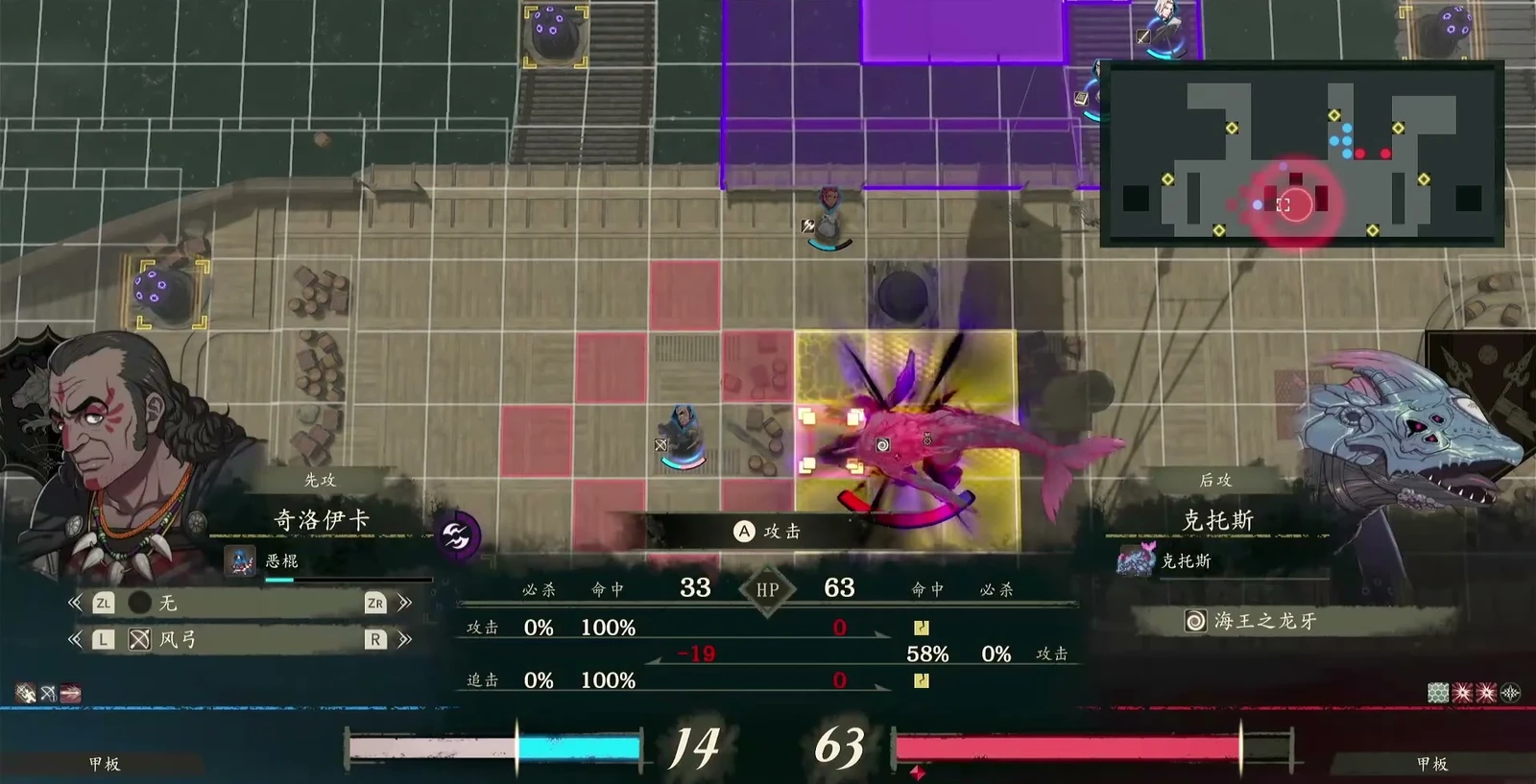
Image source:
Combat formulas at a glance
Attack Speed subtracts weight beyond Build. Effectiveness and super-effectiveness multiply only weapon Might; critical hits then multiply damage.
| Value | Formula | |
|---|---|---|
| Attack Speed | Speed − max(0, total equipped weight − Build) + skill modifiers | |
| Build | Strength / 5, rounded down + skill, equipment, and mount bonuses | |
| Follow-up | Attacker’s Attack Speed − defender’s Attack Speed ≥ 4; applies to both sides | |
| Physical Hit | Weapon Hit + Dexterity + combat art/skill/support modifiers | |
| Magic Hit | One formula is (Dexterity + Luck) / 2 + spell Hit + modifiers; another table does not distinguish physical and magic | |
| Physical Avoid | Attack Speed + combat art/skill/support/terrain modifiers; flying units do not receive ground Avoid | |
| Crit | Weapon Crit + (Dexterity + Luck) / 2 + modifiers | |
| Dodge | Luck + skill/support modifiers | |
| Actual Hit rate | Attacker’s Hit − defender’s Avoid | |
| Actual Crit rate | Attacker’s Crit − defender’s Dodge | |
| Attack | Weapon Might × (effective 2 / super-effective 3) + Strength or Magic + combat art and other bonuses | |
| Damage | Attack − Defense or Resistance, including shield and terrain bonuses; minimum 0, or 5 for an axe hit | |
| Critical damage | Damage × 3 | |
| Healing | Spell’s innate healing + Magic / 3 + personal/class skills + equipment |
Equipment weight and Build determine Attack Speed
Examples. With Speed 32, weapon weight 4, shield weight 4, and Build 5, Attack Speed = 32 − (4 + 4 − 5) = 29. Another example is  Dietrich: Speed 12, Build 2, weapon weight 4 gives Attack Speed = 12 − (4 − 2) = 10.
Build follows Strength. It does not grow independently on level-ups. Build rises by 1 whenever Strength reaches a multiple of 5: Strength 14→15 means Build 2→3. High-Strength magic classes benefit too. With the same heavy weapon and shield, they lose less Attack Speed.
Non-weapon equipment also has weight. Shields, charms, and other equipment contribute to total weight. A defensive shield can leave you slow enough to suffer enemy follow-ups and make you easier to kill instead. You can equip or remove accessories at any time on player phase. If you are 1 or 2 points short of a follow-up, remove an unnecessary shield or charm before attacking. Conversely, already-slow shield tanks such as  Goliath and
 Orchel can ignore weight and equip the toughest gear.
Follow-up order. If the opponent can counter, the sequence is “your attack → enemy counter → your follow-up.” Even very high Attack Speed does not make your two hits consecutive. Specific arts or skills can move a follow-up before the counter; see attack order, Sen No Sen, and Go No Sen.
At low levels on Hard, remove a shield when necessary to preserve follow-ups. Check whether he can follow up in this fight first, then weigh the Resistance gain. Do not copy a fully equipped late-game build.
Once Build and Speed are high enough to follow up with a shield, equip a Resistance shield to prevent a mage’s heavy hit from defeating him.
How Luck affects Hit and Avoid
Separate physical and magic attacks first. Physical Hit uses weapon Hit + Dexterity + modifiers, while physical Avoid starts with Attack Speed. If weight exceeds Build, removing unnecessary heavy equipment may improve both follow-ups and physical Avoid. Luck also contributes to Crit and Dodge. Its absence from physical Hit does not make it useless.
Magic Hit has differing classifications. One formula uses “(Dexterity + Luck) / 2 + spell Hit + modifiers,” with separate physical and magic calculations. Another formula table does not make that distinction. A player also reported magic Hit increasing after raising Luck, consistent with the former formula.
Compare forecasts against the same target first. When testing formulas, hold character, spell, and target fixed. Change only one thing at a time: Luck, one heavy item, or entering/leaving woods. Then record physical and magic forecasts.
Weapon traits replace the triangle
| Weapon | Trait |
|---|---|
| Sword | Follow-up hit damage ×1.2 |
| Spear | Effective against cavalry: weapon Might ×2 |
| Axe | At least 5 damage on hit; resolution order with special damage reduction remains unconfirmed |
| Bow | Super-effective against flying: weapon Might ×3; generally attacks only from at least 2 tiles away |
| Gauntlet | Easier to evade attacks from non-gauntlet weapons |
| Magic | Targets Resistance rather than Defense, countering heavy armor; some swords, spears, and axes also use magic Attack, such as Levin Sword |
The sword’s 1.2 multiplier applies only to its follow-up, so Myrmidons need high Attack Speed to benefit. Axes have low Hit but a 5-damage floor, useful against high Defense. Gauntlets also include special firearms that can attack from at least 2 tiles away.
A gauntlet’s Avoid bonus depends on the specific weapon. Fully forged Wooden Gauntlets give +15; Bronze, Iron, and Damina Gauntlets give +10; Silver Gauntlets give only +5. Higher-tier gauntlets rely less on evasion.
Recognizing the sword bonus. In Leda’s two-hit example, the first hit deals 11 and the follow-up 13, due to the sword’s follow-up bonus. Against a target whose Defense prevents meaningful damage, consider the axe’s minimum damage instead. Inspect both forecast values before changing weapons. The complete rounding rules for 1.2× remain unresolved. Spear and bow multipliers apply only to weapon Might, as explained below.
Effectiveness multiplies only weapon Might
Multiply only weapon Might, not Strength. An Iron Bow with Might 9 uses Might 27 against a flier, then adds Strength. When using bows against fliers, prioritize Hit, then Speed, with Strength lower. Weapon Might is already tripled, so small Strength differences matter less. Fliers also have high Avoid and often abilities that increase Avoid against bows.
- Large enemies’ barriers: One effective or super-effective attack removes 2 barrier layers from large enemies such as War Elephants.
- Preventing super-effectiveness: Cavalry and fliers can dismount or land to remove their spear or bow weakness; see mounts and riding. The Shield of Zephyrus, rewarded by Jurah’s Part 3 trial, nullifies flying super-effectiveness.
Terrain Avoid and adjacent support
Terrain Avoid:
| Terrain | Avoid | |
|---|---|---|
| Grass | +20 | |
| Brush/woods | +30 | |
| Dense brush/woods | +40 | |
| Desert | −20 | |
| Wasteland | −40 |
Other terrain includes sand that reduces Movement except for magic types, and woods that reduce Movement except for Hunter and brawling types. Cavalry and heavy armor suffer the largest penalties on unfavorable terrain. There are healing and damaging tiles; emplacements (ballistae for bow types, fireballs for magic types, catapults for anyone, with limited uses and no use in rain); warp tiles; explosives; and breakable obstacles. Walls block even fliers, but ranged attacks can cross them, and Dietrich’s Blaze Arts can pass straight through.
Adjacent support. Adjacent allies at Bond Level 2 or higher give both units combat bonuses. In Clashes, everyone counts as adjacent. Class and character pairing provide separate bonuses:
- Class bonus: values depend on the class family of the unit giving the bonus. They begin at Bond Level 2 and peak at level 5.
- Chain Bonus: specific pairs give an extra bonus from Bond Level 2. Do not judge solely by whether they have support conversations. A few pairs without conversations also have Chain Bonuses, and Attack Speed bonuses belong to this pairing layer. After positioning adjacent allies, check the actual forecast bonuses.
- The forecast’s upper-left corner shows the actual bonuses: press X, then up.
Other examples include physical Attack +3 and Hit +5 from infantry melee types, Hit +10 and Dodge +5 from bow types, and Avoid +5 and Crit +10 from Dancer. Four Bond Level 5 Soldiers surrounding one unit can provide a combined Protection +12. Decide who gives the bonus to whom, then check class, Bond Level, and specific pairing, and finally the combat forecast.
Forecast targeting lines and red crosses
- Line colors above enemies: red = normal attack; yellow = high Crit, normal attack or art; purple = a weapon effective or super-effective against you; dark purple = Blaze Art. Hover over an allied unit to see which enemies will attack it and with what.
- Red X: in the damage forecast, a red X means the unit falls if all the opponent’s follow-up attacks hit without any criticals.
- ZL displays all enemy attack ranges. A pins an individual enemy’s range; X shows detailed stats and equipment.
Calculate shield weight, Build, and effectiveness separately
- “This game has a sword–lance–axe triangle”: it does not. Weapon-type traits replace it.
- “Build grows independently”: it does not. Build = Strength / 5, plus skills, equipment, and mounts.
- “Only weapon weight affects Attack Speed”: shields, charms, and other equipment count too.
- “Speed only affects follow-ups”: physical Avoid also starts with Attack Speed.
- “Super-effectiveness triples all damage”: only weapon Might is tripled; Strength is not.
- “Every sword hit gets 1.2× damage”: only the follow-up does.