

Anatolia’s and Orchel’s mysterious bodies: gauges, class restrictions, and masksMajor spoilers
Anatolia resembles a vessel for divine power, while Orchel seems closer to an automaton. The body’s origin and the soul’s identity may be separate questions.
Original video: Is Eshmel not the only artificial person? Character analysis, episode one | Bilibili creator Tianluo luo
 Anatolia resembles a vessel for divine power, while
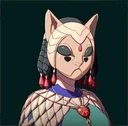 Orchel seems closer to an automaton. The body’s origin and the soul’s identity may be separate questions.
Two sets of clues about artificial life
 Eshmel may not be the only artificial life-form. Clues surrounding Anatolia and Orchel point toward two different methods of creation: a body containing divine power and a doll capable of independent action.
Look first at bodies and system classifications, then at clothing, mythology, and relationships. That gradually connects these two mysteries.
Anatolia’s homeland and gauge
Anatolia’s identity description suggests a being artificially designed to serve gods. Her special gauge matches Eshmel’s, and her icon differs from other characters’. Together, these suggest that her body was also manufactured in some way.
She enters the Heroic Games to save the people of her homeland and says she comes from west of Dagda. Nearby dialogue repeatedly mentions water shortages and rationing. This adds another meaning to the story associated with Eshmel’s name: in Genesis, a mother and son run out of water in the wilderness, then survive after divine guidance leads them to a well.
Cultural clues in clothing and firearms
The white head covering, metal forehead ornament, and long skirt initially suggest bridal clothing. But the split hem, thigh straps, and freely moving wrists and ankles leave room for combat. Her white feathered cloak spreads like wings, also echoing the image of a Pale Raven bride.
She uses the I Ching for divination, practices martial arts, and carries a portable firearm.  Hong Hua’s preview dialogue describes such firearms as standard Kunlun equipment, adding a connection to Kunlun alongside her bodily mystery.
The hexagram cast for the queen, Oppression—Lake over Water—suggests a lake without water, strength spent without replenishment, and blocked paths. “Words are not believed” also fits the tournament: however attractive a promise, actions under hardship determine the outcome. Following that interpretation, the champion’s prize, tournament rules, and actual purpose may differ from what participants understand.
Her question about whether Eshmel works with Vritra also connects to blockage. In the relevant myth, Vritra blocks the waters and must be defeated before rivers flow to the sea again. Her homeland’s water shortage, the Oppression hexagram, and this name gather around the same theme of obstructed resources.
Orchel’s armored classification
Orchel usually wears a cat mask. He is gentle and skilled at healing and support, yet possesses remarkable close-range strength. Even in a cloth-robed magic class, the system treats him as armored. His introduction also specifically emphasizes that his body prevents access to some classes.
That suggests a structural restriction. The gear icon and automaton classification bring extraordinary strength, armored status, and class restrictions into one explanation: this body may have been made according to automaton rules.
Credna, whom he has long served, connects to knowledge, technology, and creation, supporting a further theory that this god made his body. But the mark on his chest differs from the pattern used while casting. Who created the body and whose soul it holds may be separate questions.
Whose identity does the ritual mask conceal?
When  Theodora asks about the mask, he immediately says there is a long story behind it and that he must never remove it in public. Masks in religious rituals cover individual identity so people see the role of a god or priest. Following that idea, the temple may allow others to see only his priestly identity.
The name offers another clue through Saint Roch. In legend, he cared for the sick, then contracted illness himself and was saved by a dog bringing bread. Healing, closeness to animals, and a mark on his chest all offer parallels with Orchel’s design.
The golden cat mask, shoulder feathers, wooden staff, butterflies, and purple-and-green robe connect him to forests, animals, and temples. His body also resembles the mythological golden handmaidens who understand, speak, possess strength, and work for gods: extraordinary power, divine service, and domestic skills such as cleaning, laundry, cooking, and plant care.
Lifelong loyalty hints at the soul within
Orchel enjoys animals, music, and reading. Speaking of his lost homeland, he says that home and country are a person’s roots and cannot easily be abandoned. These personal habits make the theory of a real soul within the body more compelling.
His relationship with  Diego is especially interesting. Someone who may have been created to serve a god receives another person’s lifelong loyalty to him as an individual. The key questions are what the body under the mask actually looks like and whose personal memories it carries.