
Money and shops: earning priorities and costs you can cut
Prioritize protagonist quests and timed paralogues, then save through discounts and material exchanges. Inn auto-exploration becomes substantial income with a larger roster. Save before buying weapon crates.

Earn money from exclusive quests and timed paralogues first. Do not miss large rewards for scattered drops. Save money by scheduling training and meals on discount days.
Start with protagonist-exclusive quests, and check deadlines when paralogues appear. Cai’s requests and Leda’s local performances can each pay thousands of gold. Paralogues provide major income during preparation for later parts; do not miss them while farming small drops.
Prioritize quests before automatic exploration
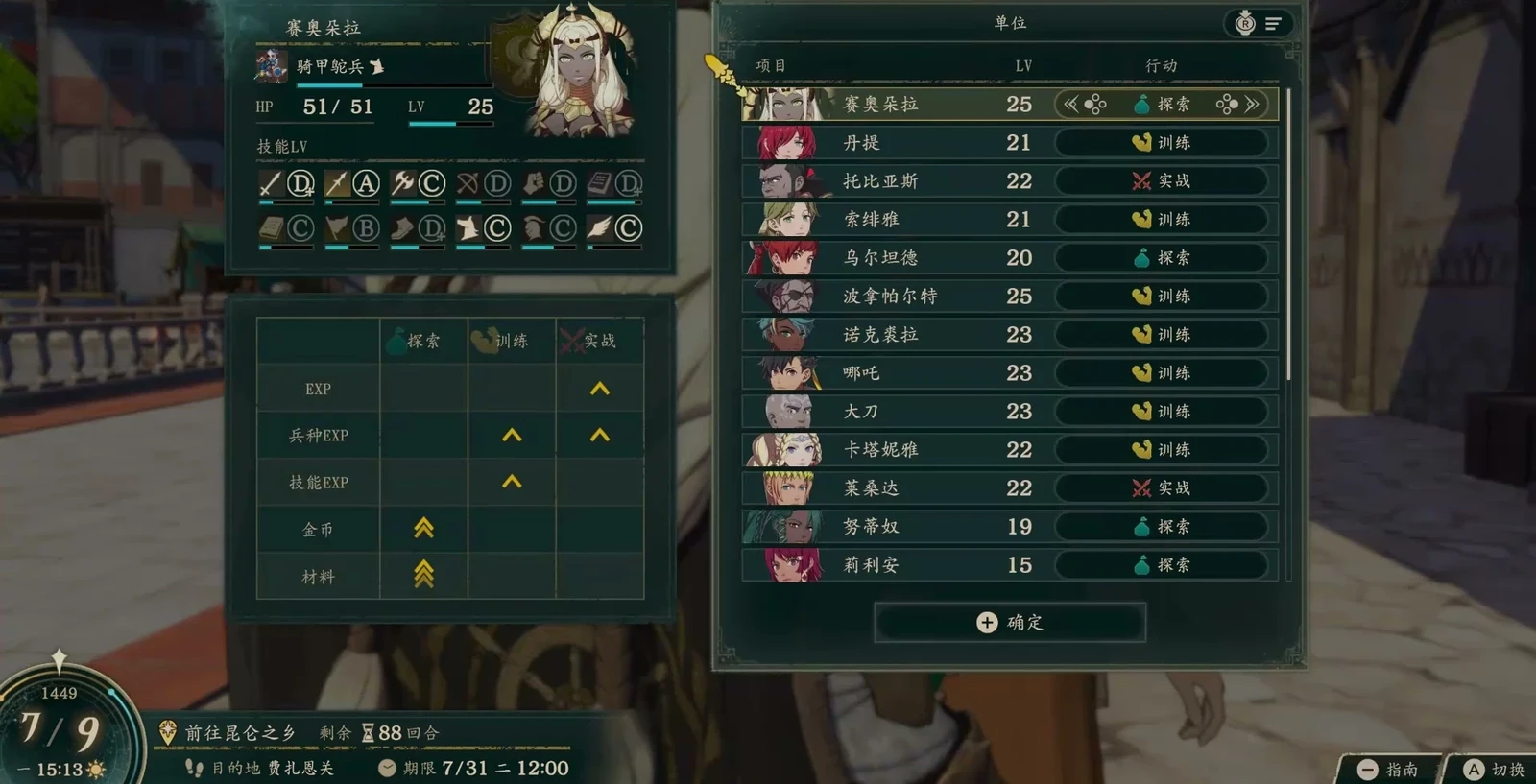
Start with quests, paralogues, and protagonist-specific activities, then consider gathering points and automatic exploration. Quest rewards are predictable, paralogues pay well, valuable random gathering items are not guaranteed, and automatic exploration needs enough participants to build substantial income. There is currently no unconditional early-game route to infinite money.
Use this order: exclusive quests first, with exploration and side quests alongside them. A golden mummy’s ordinary Bullion sells for 600G, but this random third-party enemy may escape or be killed by another enemy. Collect the bonus while leveling rather than spending an entire preparation period waiting for one.
- 1Check dates at the chapter’s start:look at quest deadlines and paralogue dates first.
- 2Combine objectives in one direction:group requests, supplies, performances, and exploration into one trip.
- 3Use spare turns for smaller gains:fight encounters or arrange auto-exploration afterward.
Money and Renown often come together, also saving repeated travel. See the world map.
What should each route prioritize for money?
| Route | Priority income | Restrictions |
|---|---|---|
 Cai | Help quests; sewer enemies dropping Insect Pearls | Insect Pearl 300G, Large Insect Pearl 1500G; cleared dungeon enemies return next chapter |
 Dietrich | Encounters forced by Blade Resonance; challenge letters and other quests | Encounters give experience, materials, and some Renown; avoid detours for distant enemies about to disappear |
 Theodora | Military preparation delivery quests; materials from exploration dispatch | Keep materials for quests and upgrades before selling surplus |
 Leda | Local performances and tavern quests | Some quests also require Renown; check conditions and delivery deadlines |
| All routes | Timed paralogues, side quests, and theater performances from Renown 8 | Performing and watching share a weekly opportunity; performing also costs Motivation |
The sewers are a dungeon. Their enemies respawn next chapter.

When a golden enemy appears, pursue it manually to collect the money. Golden mummies have high HP; automatic attacks may let them escape before finishing them. Manually assign pursuers, defeat the target, then sell the Bullion. This explains collecting money after an encounter, not a method where repeated automatic battles guarantee golden enemies. Check its escape direction and enemy threats before choosing an interceptor. One small squad earned only a little over 400 gold in four Auto-earn turns. Do not budget a small team using a late-game full team’s income.
Which shops can save you money?
| Shop or facility | Main use | Check before buying |
|---|---|---|
| Weapon shop | Replenish weapons; forged weapons after certain Renown levels | Route, timing, stock, and price |
| Item shop/examiner | Healing and utility items, Certification Exam licenses | License tier and remaining stock; regional shops can be cheaper |
| Market/gift shop | Ingredients and gifts | Existing stock, recipient preferences, and whether you already gifted them this week |
| Vandahl Trading Company | Exchange materials for weapons, equipment, crates, and other goods | Whether materials are needed for quests or upgrades |
| Traveling merchant | Buy particular goods with gold | Location and stock; separate from the company’s material exchanges |
| Blacksmith | Repair and forge | Whether your weapon truly needs replacing or only repair/an upgrade |
Exam license stock in the imperial capital is limited, and regional merchants may be cheaper. Check Certification Exams before changing class. An empty shelf in the capital does not mean no more exams this chapter.
Weekend discounts and dispatch income
For savings, check the calendar and Boons of Salvation first. Training is half price on Saturday and Sunday; meals are half price on Sunday. Make Sunday a “capital day.” If you have unused weekly activities, spend them on Saturday, then do the new week’s after Sunday’s reset. Anniversaries may also offer discounts; follow the actual calendar.
Boons of Salvation reduce weapon, item, gift, and later facility costs. They suit frequently repeated purchases. See Blessings and Boons of Salvation for choices and unlocks. Do not budget with unverified discount percentages.
Automatic exploration suits a large roster, no urgent quests, and spare turns to spend. Sending everyone once the team grows has produced examples of ten to twenty thousand gold accumulated. Small rosters or short durations give limited returns. Exploration income varies with participants and time. Give an individual a different activity if they urgently need skill experience.
The initially imported storage and supplies later redeemed with fragments have different opportunity costs.
Prioritize Part 1 exploration, rare materials, and mounts, leaving some expensive recruits for later.
You do not need to optimize storage for repeated playthroughs.
Before selling materials, replacing weapons, or buying gifts, list current recruitment and later reconstruction needs, then consider selling the surplus. Do not turn a standard first run into repeated farming to satisfy a “perfect first-run inventory” list. Whether to unequip ordinary equipment and when mounts lock in remain disputed. Check inheritance records before storing supplies.
Save before buying weapon crates
Quality Weapon Crates can contain effective or specialized weapons; Luxury Weapon Crates offer rarer weapons.
- 1Prepare and save before purchase:stand at a merchant selling Weapon Crates, leave one space in the protagonist’s inventory, then save. Having the crate go directly to the protagonist saves steps when opening it.
- 2Buy and open:check the contents.
- 3Reload if unsatisfied:return to the title screen and load the save from before purchase.
Weapon Crate contents are determined when acquired. Save before buying if you want to reroll. Saving after acquiring the crate but before opening is a different operation. Do not apply this method to certification exams; their result-saving rules differ.
Rerolling Weapon Crates takes time. One approach farms crates for weapons with special uses. Another limits rerolling: one record took about 50 attempts for one Levin Sword, making targeted farming too slow. During normal progression, prioritize guaranteed rewards and timed quests. Consider this process when you need one specific weapon and are willing to reload repeatedly.
Do not miss paralogue deadlines for small random income
- Do not miss paralogue deadlines for random golden mummies. Finish guaranteed, expiring high-value quests first.
- Do not treat the sewers as a weekly reset. Plan for enemies refreshing next chapter.
- Trading-company materials may be needed for quests or upgrades; check their uses before exchanging.
- Normal weapon attacks do not consume durability. Do not replace weapons in batches just because you fought a few battles. See durability and forging for repairs.
- Auto-exploration builds income through squad size and turns. Early small teams cannot match late-game returns.