

Connections to Three HousesMinor spoilers
The same world, about 727 years earlier, on another continent: Seteth appears in person, Dietrich is the great-grandson of Lamine of the Ten Elites, and Bloodmarks are Fódlan’s Crests. Deeper answers about Sothis, Agartha, and Nemesis emerge in Part III.
- It is a prequel, set roughly 727 years earlier. Matching a shared event between the games suggests that 1449 here corresponds approximately to Imperial Year 453 in Fódlan. Three Houses begins in Imperial Year 1180. The reasoning follows below.
- Three connections you will notice early, without spoilers: Seteth comes to Dagda under the alias Seteth; Dietrich comes from Fódlan carrying the Hero's Relic of Lamine of the Ten Elites; and this game's Bloodmarks are what Fódlan calls Crests, with different names but corresponding types.
- The deeper connections arrive in Part III: what Sothis is, why the Agarthans hate the goddess, and how Nemesis was originally empowered. This game provides far more answers than Three Houses did.
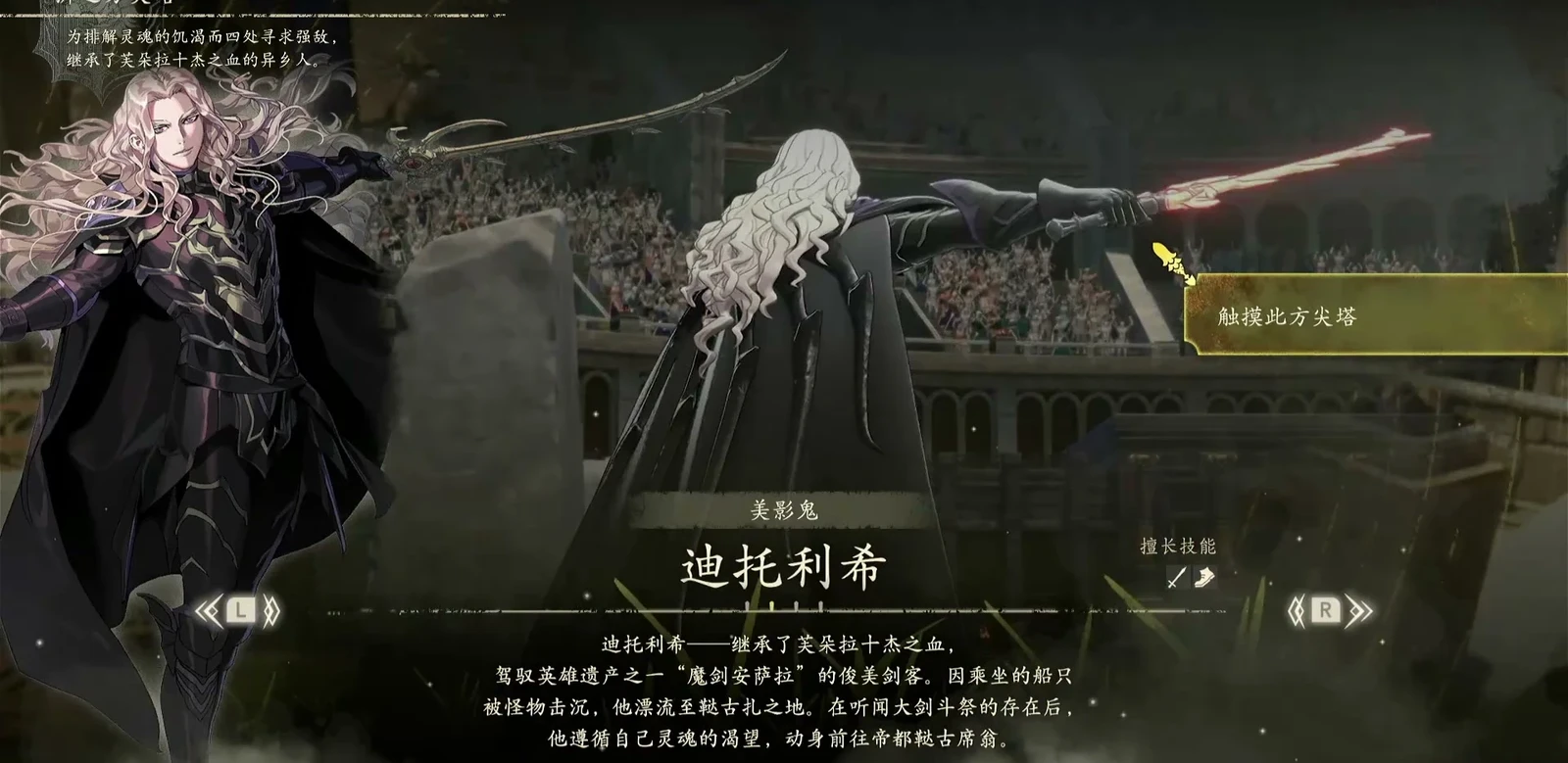
Calculating a gap of roughly 727 years
This game uses the Dagdan calendar, while Three Houses uses the Adrestian Imperial calendar. Conversion relies on events dated in both games, with Support dialogue helping narrow the range.
Calculation 1: In Dietrich and Fabio's C support, Fabio says Garreg Mach was founded more than 260 years ago. Three Houses' histories date its foundation to Imperial Year 185, placing this game after roughly Imperial Year 445. Two further clues support this:
- Dietrich belongs to House Lamine. That family no longer exists in the Three Houses era, showing it has not yet died out here.
- In Little Bird Time dialogue, Seteth confirms his daughter Flayn is still asleep. She only wakes in 1179, the year before Three Houses begins.
Calculation 2: compare invasion records in both games. Find an event dated in both. Three Houses' library text, A History of Fódlan, Part II, records the Empire's failed invasion of Dagda through Brigid in Imperial Year 731. One protagonist's ending here records Adrestia invading from Fódlan in Imperial Year 1727. Treating the two accounts as the same war gives a 996-year difference: 1727 − 731. This is inferred from a shared event; the game does not directly provide a conversion formula. Using it gives:
| This game's year | Fódlan Imperial Year | Event |
|---|---|---|
| 0 | 996 before the era | Dagdan Empire founded |
| 997 | 1 | Adrestian Empire founded |
| 1181 | 185 | Garreg Mach founded |
| 1449 | 453 | Heroic Games |
| 1454 | 458 | Balor's resurrection |
| 2176 | 1180 | Three Houses begins |
The shared-event calculation matches the support dialogue: 453 − 185 = 268, within “more than 260 years.”
Year conversion does not directly convert months and days. Dagda's year begins in the first month, while Fódlan's Imperial year begins in the fourth. Events near the year's start need date checks. Early videos describing the period as undetermined predate this post-release timeline.
SpoilersWhose ending supplies calculation 2?
It is Cai's solo ending. After the war, he travels Dagda and much later becomes a general under a ruler who unites the continent. When Adrestia invades in Imperial Year 1727, he alone faces over twenty thousand enemies, refuses to retreat, and dies from exhaustion. Cai lives nearly three hundred years and has divine blood (see story revelations). “Imperial Year” in this ending refers to the Dagdan Empire's calendar.
See the Timeline for the full comparison.
Dagda lies southwest of Fódlan
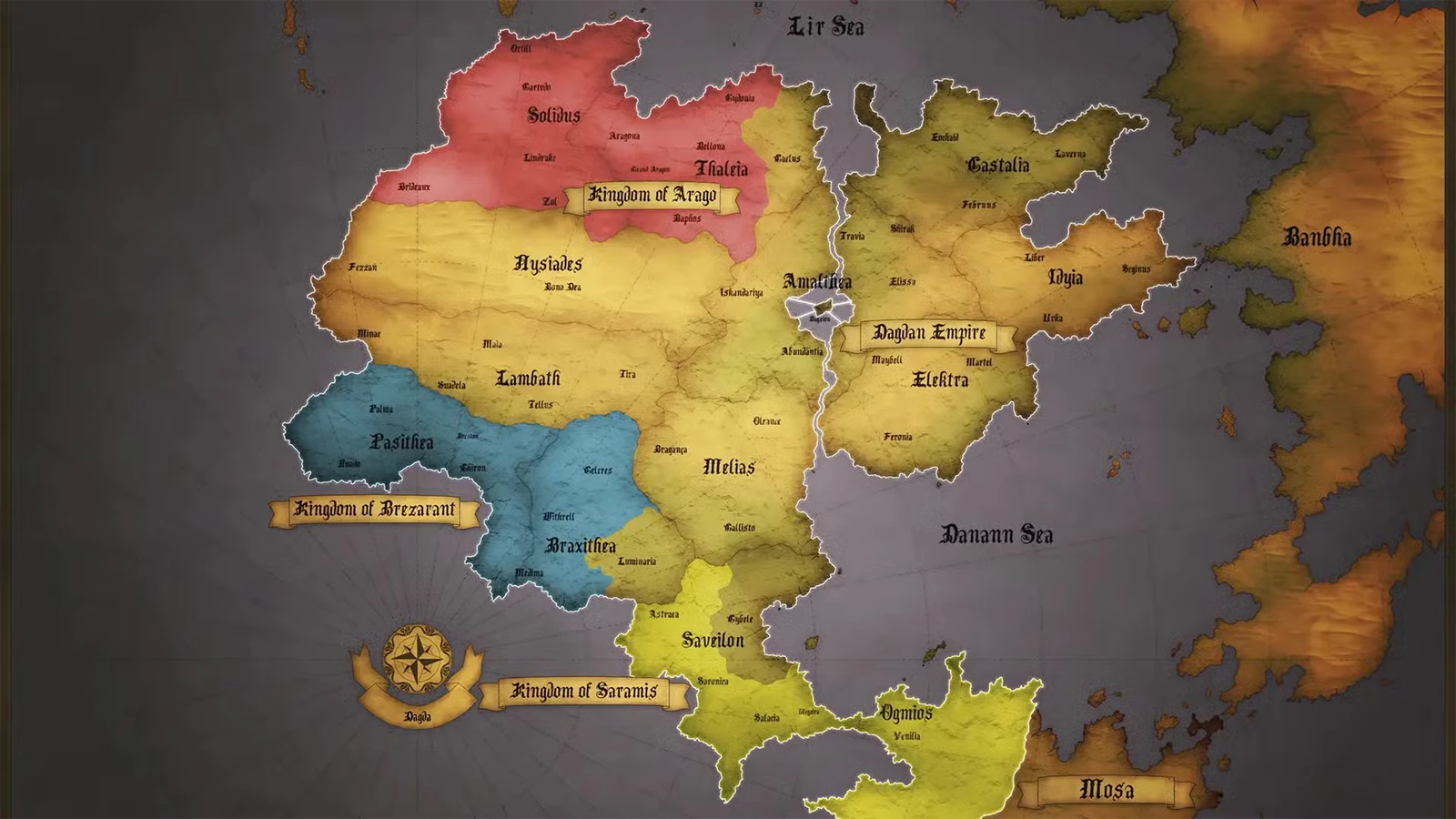
The older game records distant travelers' accounts. Three Houses' library text, A Traveler's Journal, places Dagda southwest of Fódlan, while rumors disagree between tropical rainforests and frozen plateaus. The Brigid archipelago lies between the continents.
Read the empire, the three kingdoms, and their architectural atmosphere alongside the continent map and an ancient Mediterranean setting.
Three Houses and Three Hopes describe Dagda as west of Brigid, while this game's map places it almost due south.
Dagda in Three Houses' records
The wars mentioned in Three Houses and Three Hopes all occur after this game's Heroic Games, at different intervals. They are not chapter events from this game's Part II War story. The 731 invasion also appears in Cai's particular solo epilogue, but that does not make it a shared ending for every route.
Taking the Heroic Games as approximately Fódlan Imperial Year 453 gives these intervals:
| Fódlan Imperial Year | Approximate years after the Games | Event | People connected to it |
|---|---|---|---|
| 721 | 268 | First Mach War: Dagdan forces cross the sea, are repelled, and devastate the Mach region | — |
| 728 | 275 | The empire attacks Dagda's ally Brigid | — |
| 731 | 278 | The empire launches a major invasion of Dagda through Brigid and fails |  Cai's ending in this game records this war |
| 1175 | 722 | Dagda and Brigid War: the two countries' allied invasion is turned back by Count Bergliez alone | Shamir loses her partner and becomes stranded in Fódlan, later joining the Knights of Seiros; Petra loses her father and becomes an imperial hostage; Constance loses House Nuvelle |
- Fetters of Dromi: a Hero's Relic associated with the Crest of Aubin, obtained in Yuri and Constance's paralogue in Three Houses. Duke Gerth, who holds it, says Dagda sent it as a token of friendship after the ceasefire. He links it to the possibility that surviving followers of the Ten Elites fled overseas from Seiros. Three Houses had already foreshadowed Relics reaching Dagda.
In Three Hopes, Shamir also tells Hapi that the pagan statue in Abyss represents Dagda's deity of fate. The inference is that this corresponds to this game's goddess Fortuna.
Familiar faces and old families in Part 1
Seteth roughly 700 years earlier
Seteth is recruitable here as part of Orchel's team. He leaves Fódlan in 1448 and investigates the Dagdan Empire under the alias Seteth. Beasts surround him on the way, and Orchel rescues him. Watching the Heroic Games, he recognizes House Lamine's Hero's Relic. Afterward he approaches Dietrich, asking why Lamine's heir is in Dagda and questioning his notorious reputation in Fódlan.
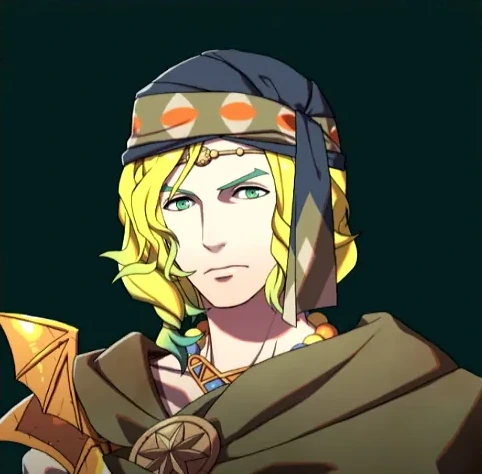
In his ending, he returns to Fódlan after the war and writes a book of his experiences in Dagda for the archbishop. It is never published, remaining hidden in the archbishop's private library at the monastery. Some historical passages in the game are attributed to “Saint Cichol, Travels in Dagda.”
Dietrich and House Lamine
- His full name is Dietrich Gregor Lamine. Fabio recognizes him as a descendant of Lamine of the Ten Elites and remarks on his beauty. Dietrich replies that his great-grandmother died long ago and he never met her.
- His demonic sword Answerer bears the name of the Hero's Relic corresponding to the Crest of Lamine in Three Houses.
- House Lamine no longer exists in the Three Houses era. Mercedes and her brother Jeritza, the Death Knight, carry the Crest of Lamine.
SpoilersDietrich's ending and the lost Relic
In Dietrich's solo ending, he dies on a battlefield somewhere in Dagda late in life. His badly damaged sword returns to Garreg Mach and is locked away from public view as a lost Relic. This explains why nobody uses it in Three Houses. In Part III he ties his hair over his left shoulder with a black ribbon, matching Mercedes's hairstyle in Part I of Three Houses.
How was the Lamine connection inferred before release? An investigation after the first trailer connected three clues:
- Dietrich's family emblem combines a realistic horse with a Crest. This is how Fódlan nobles depict heraldry, unlike Dagda's stylized flags, indicating he comes from Fódlan.
- His personal skill Murderous Intent shares Jeritza's skill name. His sword's combat art, Bloodletting, also echoes Three Hopes' folk tale of a reaper draining blood in the Mach region.
- House Lamine does not exist in the Three Houses era.
Post-release dialogue confirms Dietrich's Fódlan origins and Lamine as his great-grandmother. The shared-event timeline places the game roughly 727 years before the older title.
Prerelease analysis guessed a generational link from the shared Crest without knowing which came first. A shared Bloodmark only suggests a connection between powers. Lamine's great-grandmother relationship comes from dialogue; other close family relationships need individual evidence and cannot be generalized from Dietrich.
Fabio
Fabio is a mysterious missionary of the Church of Seiros from distant Fódlan. He is rational but has a habit of calling others “beasts.” He and Dietrich come from the same homeland but do not know one another.
SpoilersFabio's true identity
His true name is Anacharsis, and he is Agarthan, one of those who made Crest weapons. He made Lamine's sword and the Rafail Gem. His ending title is “Agartha's Servant”. In Three Houses, those who slither in the dark call both humans and the goddess's children beasts. This is the origin of that verbal habit.
Esmeralda
She comes from a Dagdan coastal fishing village and bears a Bloodmark corresponding to Fódlan's Crest of Blaiddyd. Because it belongs to none of Dagda's gods, her village offers her to a sea beast, and Dietrich rescues her. In Three Houses, Blaiddyd is the Crest of the Faerghus royal family, including Dimitri.
Bloodmarks and corresponding Crests
This game's Bloodmarks are called Crests in Fódlan. Dagdan Bloodmarks come from the blood of Dagda's gods, are rarer than in Fódlan, and do not determine social status as they do there.
Bloodmark and Crest comparison, including bearers
| Bloodmark | Three Houses Crest | Bearers in this game |
|---|---|---|
| Diadem of the Fanatic | Crest of Ernest | Raksha, Anna |
| Diadem of the Earth | Crest of Dominic | Dagda, Kalla,  Leda, and others |
| Diadem of Revival | Crest of Fraldarius | Dagda, Jurah, Vandahl,  Fianna, and others |
| Diadem of the Auger | Crest of Noa | Dagda,  Eshmel, Solel, and others |
| Diadem of the Victor | Crest of Daphnel | Mars,  Bertrand |
| Diadem of Valor | Crest of Blaiddyd |  Esmeralda and others |
| Diadem of Reflection | Crest of Gloucester |  Ninae |
| Diadem of Balance | Crest of Cichol |  Seteth |
| Diadem of the Apostle | Crest of Aubin | Balor, Aurora, Cai,  Orchel |
| Diadem of Duality | Crest of Gautier | Balor, Orchel, wielders of Drake’s treasures |
| Diadem of Constancy | Crest of Indech | Balor |
| Diadem of Fetters | Crest of the Beast |  Ursula |
| Diadem of the Endless | Crest of Lamine |  Dietrich |
| Diadem of Entirety | Crest of Flames | Fortuna |
A shared Bloodmark still requires separate evidence of kinship. Esmeralda's mark alone cannot establish a family relationship with the older game's prince, and decorative symbols have limits too. Fabio and Dietrich share a Crest without being relatives.
Cai, Aurora, and Balor sharing a Bloodmark is a story clue; their mother-and-son relationship requires dialogue and personal histories. Fortuna's Crest of Flames and her identity also need separate evidence.
Part 3 reveals the older game's history
SpoilersWhat is Sothis?
Part III reveals several layers:
- Sothis came to this planet from far away, from what she calls a shimmering blue star. She used a little of her own genes and human tissue to create seven first children, the Founders, called the seven pillars by Japanese players. Emperor Dagda and the Demon God Balor were among them. The Founders reproduced with humans to create Nabateans. Their power split into twenty-one forms, the origin of the twenty-one Crests/Bloodmarks, with three per Founder.
- Sothis's true body is an immense being buried beneath a temple. The Sothis who speaks to humans is an avatar or replica modeled on her first human friend, filled with her soul when seated on the temple throne. She also created several avatars to observe the Founders in different places. Fortuna is one of them, explaining her Crest of Flames and the emperor's remark that it is hard to say whether she counts as his daughter, calling her a monster.
- Under this account, the Sothis whom Nemesis killed and whose heart Rhea preserved in Three Houses was the avatar in Fódlan.
:::
SpoilersThe Great Undoing and the Agarthans
Three Houses gives the Agarthans, or those who slither in the dark, javelins of light, the underground city Shambhala, long lives, and hatred of the goddess. It only offers scattered clues to why they hate her and where their technology came from. Connecting both games, Three Houses supplies the broad framework; this game adds details.
The additions: during the thousands of years Sothis and her children slept, humanity became a spacefaring civilization. A superintelligence on the moon, Vritra, coordinated Grand Megaliths around the world. An earthquake exposed Sothis's true body. Vritra ordered javelins of light fired at it, awakening Sothis and the Nabateans. The world burned and billions died in the Great Undoing. Survivors hid in underground facilities; the Agarthans were one group. Their hatred and javelins of light in Three Houses stem from this history.
This game also formally incorporates a Three Hopes element: the ancient Agarthan scholar Epimenides is mentioned here.
SpoilersHow Nemesis was empowered
Three Houses tells you Nemesis robbed the Holy Tomb and had support behind him. Here, Fabio, or Anacharsis, speaks as a participant: they found a man and sent him to steal the goddess's bones, blood, and Crest Stone. The Agarthans used them to develop the first Crest weapon, the Sword of the Creator. Humans learned that killing gods could yield power and began repeated dragon hunts. Warriors who obtained Heroes' Relics numbered far more than ten. Some died slaying dragons, some in internal fighting, and some were consumed by their weapons. The Ten Elites were merely the few who remained in historical records.
References hidden in names
- Blaiddyd, Lamine, Dominic, and others: This game's English Bloodmarks are all named as diadems. Their correspondences bring Three Houses' family names into the comparison; see the table above.
- Cethleann and Balor: Flayn's true name derives from the Irish mythological Cethlenn, Balor's wife in the myth. This game's Demon God is Balor. Both games draw names from Irish mythology, but there is no official statement on whether the connection is deliberate or coincidental.
- Additional-content prototype weapons: The Expansion Pass contains four weapons that appeared in Three Houses, explicitly named prototypes. One interpretation treats them as early versions of Three Houses' Heroes' Relics.
For more links to other Fire Emblem games and mythology, see Series connections and name origins.